My Shopping Bag


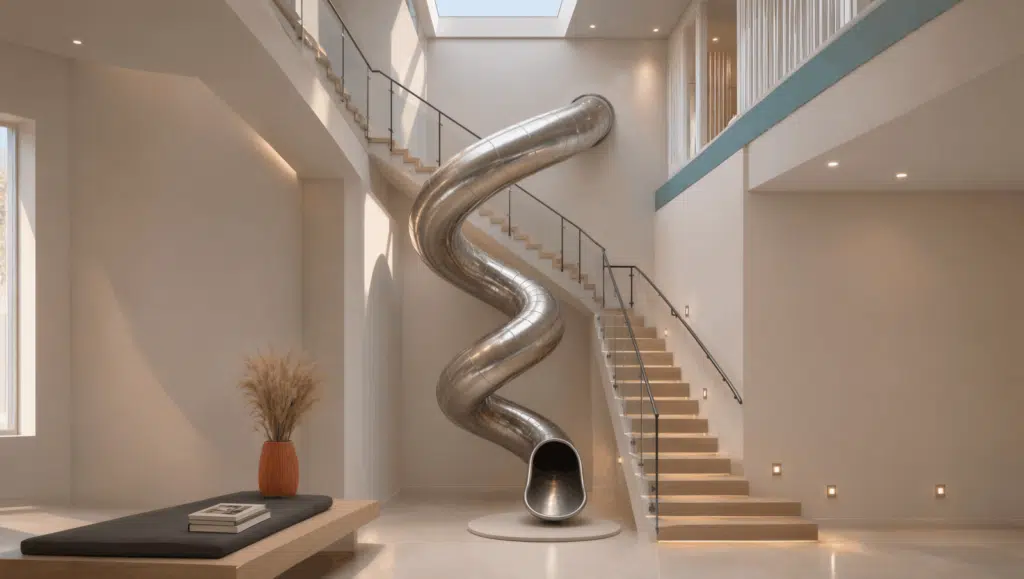
Play doesn’t have to live in the backyard or the basement playroom. In a well-designed home, it can be part of the architecture: a slide that drops beside the stairwell, or a climbing net stretched across a loft opening. Paired together, a slide and a net turn unused vertical space into the most-loved part of the house. This guide covers where an indoor climbing net and slide fit, how the two work as one feature, and what to plan before anything is built.
If you are still deciding where a slide could go, start with our custom indoor slide ideas. This post adds the second half of the combination: the net.
Most homes already have the space. Double-height living rooms, open stairwells, loft edges and attic voids are usually left empty or filled with a railing. However, those same spaces are exactly where a climbing net and a slide work best. As a result, the house gains a feature without giving up a room.
There is a design benefit, too. A slide and a net built into the structure read as part of the house, not as furniture added later. For architects and designers, that makes play a design element rather than an afterthought.
A climbing net is a tensioned net anchored to the structure of the house. Depending on where it goes, it can do several jobs at once:
The simplest way to think about the combination is up and down. The net is the way up, and the slide is the way down. For example, a child climbs a vertical net from the living room to a loft, crosses a horizontal net, and rides a slide back to the ground floor. That loop gives kids a reason to go around again and again.
Designing both at once also solves practical problems. The net and the slide share anchor points, guarding and landing zones, so they can be planned as one structure instead of two separate projects. In addition, the finishes can be matched, so a stainless steel slide and its net look like one piece of design.
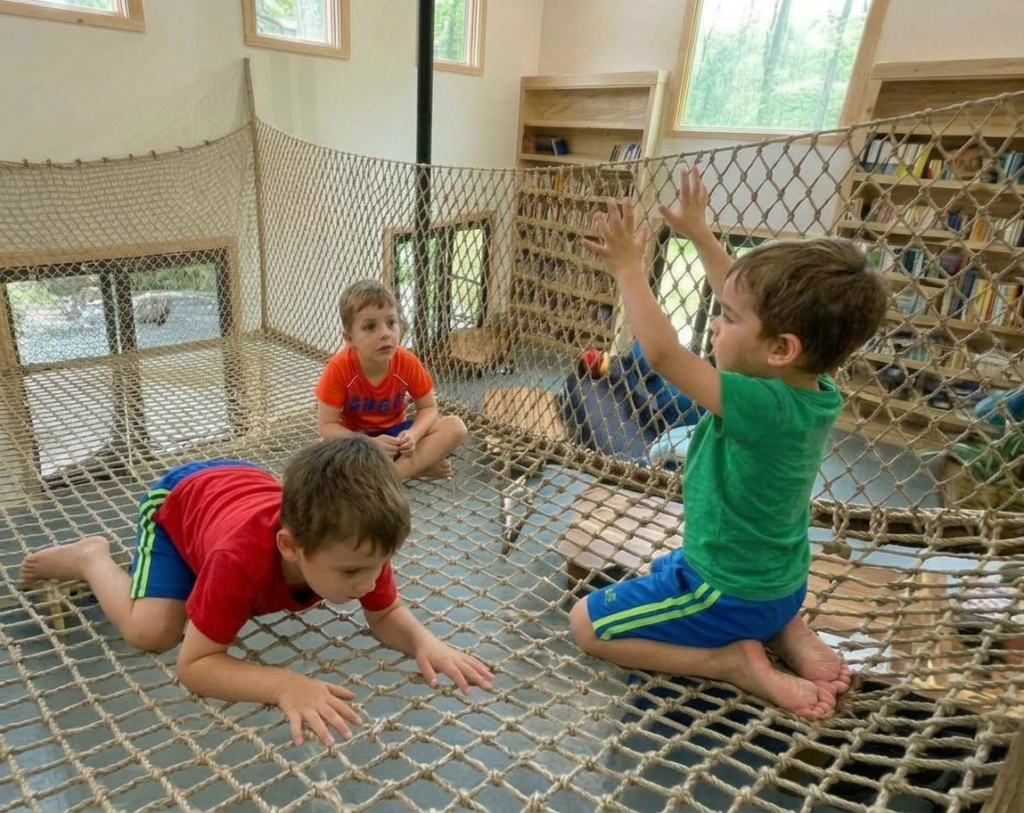
Landrec designs climbing nets as an add-on to a custom slide order or as a project on their own. If you already have a slide, or if a slide doesn’t fit the space, a net can still turn a loft opening or stairwell into play space. On the other hand, if you are planning a slide, it is easier to design the net at the same time, because the two can share structure and guarding.
Indoor play features still need the same safety thinking as outdoor playgrounds. The CPSC Outdoor Home Playground Safety Handbook is written for backyard equipment, but several of its principles carry over:
Because every home is built differently, Landrec coordinates structural review before fabrication begins. A net puts load into the framing it is anchored to, so the attachment points matter as much as the net itself. Finally, check with your local building department about permits before construction starts.
Because the slide and the net are designed together, their materials are chosen as a set.
Our stainless slides are built from 304 stainless steel and carry a 25-year warranty. We also source rotomolded plastic slides, which gives clients a choice of material and budget. Our playground slide materials guide compares the options.
Our nets are made from either steel-core fiber rope or high-tenacity polypropylene (HTPP) netting. HTPP is lightweight and highly resistant to abrasion, and it holds up well to moisture and chemical exposure. From there, color and mesh size are chosen to suit the space and the age of the climbers.
Every net and slide is designed for a specific space, so each project is quoted individually. Custom builds typically take 12 to 16 weeks.
Yes. A climbing net can be installed across a loft opening, a stairwell or a double-height room. The net is anchored to the structure, so Landrec coordinates structural review before fabrication begins.
Yes. Landrec designs climbing nets as an add-on to a custom slide order or as a stand-alone project.
The net is the way up and the slide is the way down, which creates a play loop. Designing both together also lets them share anchor points, guarding and landing zones.
The CPSC Outdoor Home Playground Safety Handbook recommends openings smaller than 3½ inches or larger than 9 inches, guardrails on platforms more than 30 inches high, and anchoring climbing ropes at both ends. Check local building codes as well.
Landrec nets are made from either steel-core fiber rope or high-tenacity polypropylene (HTPP) netting. HTPP is lightweight, highly resistant to abrasion, and holds up well to moisture and chemical exposure.
The easiest first step is a photo of the loft, stairwell or room, plus the height from the upper floor to the floor below. Send both through our custom project form, where you can attach a site plan or photo, or call (888) 857-2001. Our design team will review the space and recommend a slide, a net, or both.